
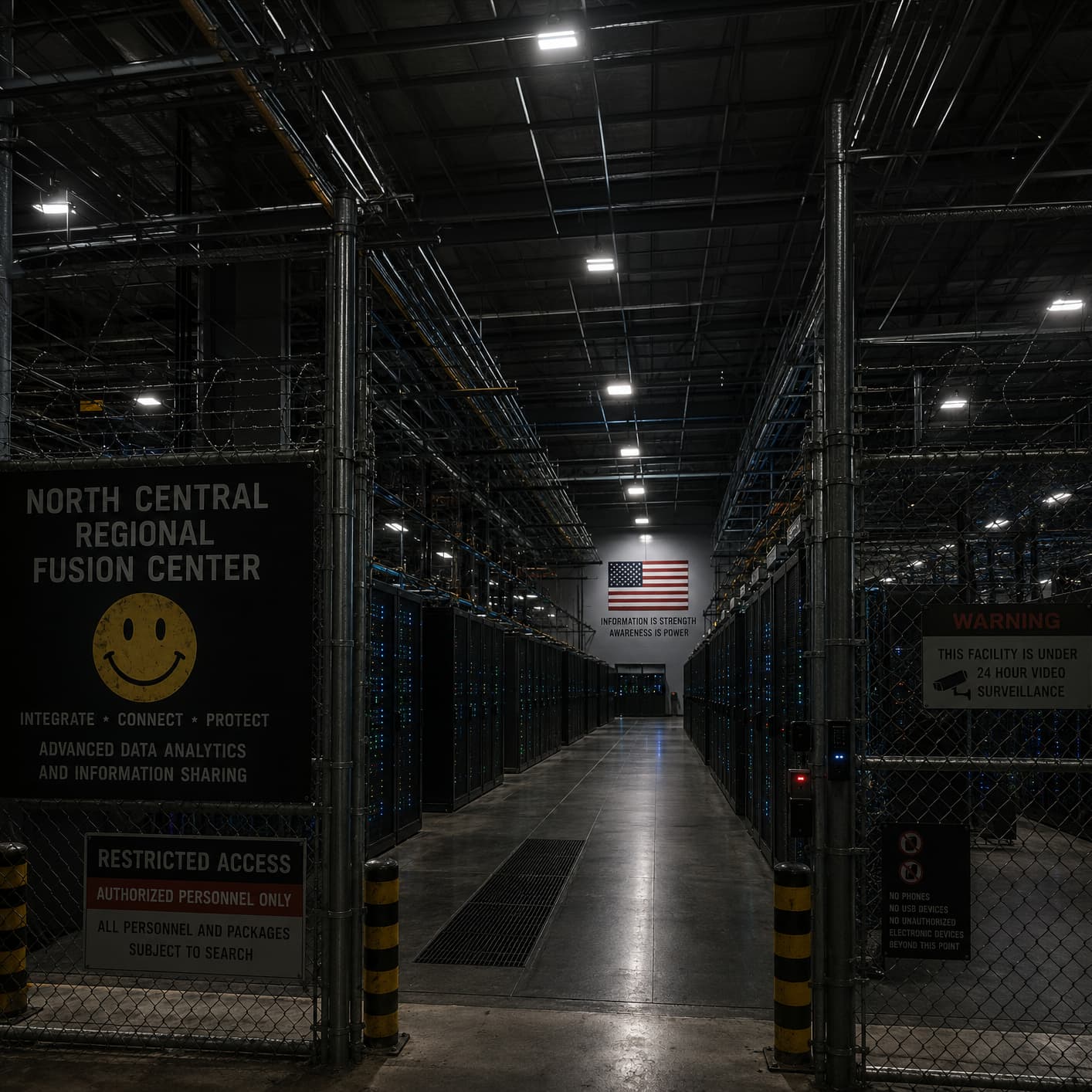
The Austin Northwestern Regional Fusion Center held a press conference Tuesday to reassure residents that its new public safety intelligence platform does not “spy on everyone,” but merely collects, correlates, scores, enriches, geofences, pattern-matches, and permanently vibes with publicly available, commercially available, voluntarily surrendered, accidentally exposed, contractually harvested, and spiritually adjacent data.
Officials emphasized that the system is not a surveillance program. “It’s an awareness environment,” said Deputy Director Carl Mervin, standing in front of a 19-screen dashboard displaying traffic cameras, license plate hits, purchase histories, drone overlays, and what appeared to be a live sentiment analysis of a woman arguing with a pharmacy self-checkout machine.
“That distinction is important,” Mervin added. “Surveillance sounds creepy. Awareness sounds like we found money in the budget.” The platform, known as CIVICSHIELD Nexus, was purchased from defense contractor Paladin Meridian Systems after a competitive bidding process in which several vendors were asked to explain how artificial intelligence could help local government become more proactive, more interoperable, and less likely to admit it had no idea what the hell it was doing. According to procurement documents, CIVICSHIELD Nexus can ingest “over 9,000 civic, commercial, behavioral, geospatial, temporal, retail, municipal, educational, transportation, utility, emotional, and miscellaneous data streams,” then generate a “Unified Community Risk Persona” for any resident, visitor, delivery driver, jogger, substitute teacher, suspiciously slow walker, or man who has cleared his browser history with “unusual confidence.”
Mervin denied that residents are being profiled.
“No one is being profiled,” he said. “They are being contextually resolved.”The Midwestern Regional Fusion Center held a press conference Tuesday to reassure residents that its new public safety intelligence platform does not “spy on everyone,” but merely collects, correlates, scores, enriches, geofences, pattern-matches, and permanently vibes with publicly available, commercially available, voluntarily surrendered, accidentally exposed, contractually harvested, and spiritually adjacent data.
Officials emphasized that the system is not a surveillance program.
“It’s an awareness environment,” said Deputy Director Carl Mervin, standing in front of a 19-screen dashboard displaying traffic cameras, license plate hits, purchase histories, drone overlays, and what appeared to be a live sentiment analysis of a woman arguing with a pharmacy self-checkout machine.
“That distinction is important,” Mervin added. “Surveillance sounds creepy. Awareness sounds like we found money in the budget.”
The platform, known as CIVICSHIELD Nexus, was purchased from defense contractor Paladin Meridian Systems after a competitive bidding process in which several vendors were asked to explain how artificial intelligence could help local government become more proactive, more interoperable, and less likely to admit it had no idea what the hell it was doing.
According to procurement documents, CIVICSHIELD Nexus can ingest “over 9,000 civic, commercial, behavioral, geospatial, temporal, retail, municipal, educational, transportation, utility, emotional, and miscellaneous data streams,” then generate a “Unified Community Risk Persona” for any resident, visitor, delivery driver, jogger, substitute teacher, suspiciously slow walker, or man who has cleared his browser history with “unusual confidence.”
Mervin denied that residents are being profiled.
“No one is being profiled,” he said. “They are being contextually resolved.”
When asked what that meant, he looked briefly toward a contractor in the back of the room, who whispered, “Don’t define it.”
The press conference was scheduled after a leaked training slide showed that analysts could search residents by name, vehicle, phone number, utility usage pattern, gym attendance collapse, loyalty card purchase clusters, doorbell camera adjacency, and “pre-incident facial attitude.”
The slide, titled Turning Everyday Life Into Actionable Shit, was described by officials as “unfortunately phrased but operationally mature.”
Civil liberties groups called the system “a rolling dumpster fire of Fourth Amendment side quests,” noting that the fusion center had quietly added data feeds from private brokers, neighborhood camera networks, school safety apps, automated license plate readers, emergency dispatch logs, social media scraping tools, toll roads, parking apps, and a smart refrigerator pilot program nobody in the county remembers approving.
“People hear fusion center and think it means agencies sharing information about actual threats,” said Lena Ortiz of the Center for Reasonable Fucking Boundaries. “What it increasingly means is some guy in a polo shirt can type your name into a contractor dashboard and find out you drove past a courthouse, bought Sudafed, stopped going to Planet Fitness, and searched ‘can stress cause eye twitching’ at 2:13 a.m.”
Officials strongly denied that analysts can access medical information.
“They cannot access medical records,” Mervin said. “They can only access non-medical behavioral indicators that may strongly imply health-related concerns through totally separate commercial lifestyle inference channels.”
Mervin then added, “Which is completely different, legally, according to a PowerPoint we paid $600,000 for.”
The system’s AI module reportedly assigns each resident a dynamic “Concern Proximity Score,” which updates in real time based on location, associations, purchases, online posts, known unknowns, inferred stress levels, irregular commute patterns, and whether someone has recently used the phrase “this place is going to hell” near a government building.
A spokesperson for Paladin Meridian Systems said the platform does not make decisions.
“It simply empowers authorized stakeholders with probabilistic risk intelligence,” said the spokesperson, reading from a laminated card. “Any resulting knock on the door is a human decision made by the appropriate agency, based on a holistic review of algorithmic insight, dashboard confidence, and whatever color the map turned.”
The company declined to explain why the map sometimes turns purple.
One county commissioner defended the program, saying residents who have done nothing wrong have nothing to worry about.
When asked whether he personally knew what data the platform collected, who had access to it, how long it was stored, whether residents could correct false information, or why the system flagged a local librarian as “logistically intense,” the commissioner said the county takes privacy very seriously and then pretended to receive an urgent phone call.
Internal records reviewed by Data Underground show the fusion center has already used CIVICSHIELD Nexus to investigate several “community anomaly events,” including:
- A retired teacher who drove past the same water tower four times because she was lost.
- A teenager whose phone connected to public Wi-Fi near three government buildings and one Taco Bell.
- A man whose electric bill dropped sharply after he went on vacation.
- A woman whose online grocery order included batteries, duct tape, and the phrase “heavy duty,” which analysts later determined referred to a shelving unit.
- A neighborhood where too many people simultaneously searched “why helicopter.”
None resulted in charges, but all were logged as “resolved through deterrent ambiguity,” which officials described as “when nothing happens and we take credit.”
Former analysts say the biggest problem is not that the system knows too much, but that it understands almost nothing.
Outside the building, residents expressed concern that the fusion center had quietly transformed from an emergency information hub into what one local father called “a municipal gossip machine with federal money and worse fonts.”
“I don’t even know who I’m mad at,” said resident Marcus Hill. “The cops? The county? The data brokers? The app I used once to pay for parking? The doorbell camera my neighbor installed because Amazon made him afraid of teenagers? It’s like everyone sold me in pieces and now the government bought the box set.”
Despite criticism, the fusion center has requested an additional $28 million to expand CIVICSHIELD Nexus with predictive modules for “pre-crime posture,” “domestic frustration mapping,” “cash transaction weirdness,” and “AI-assisted sarcasm detection.”
Officials say the sarcasm detector is essential because hostile online rhetoric is becoming harder to interpret.
At press time, the system had flagged this article as “anti-infrastructure narrative activity,” “possible satire extremism,” and “too specific to be comfortable. When asked what that meant, he looked briefly toward a contractor in the back of the room, who whispered, “Don’t define it.” The press conference was scheduled after a leaked training slide showed that analysts could search residents by name, vehicle, phone number, utility usage pattern, gym attendance collapse, loyalty card purchase clusters, doorbell camera adjacency, and “pre-incident facial attitude.”
One county commissioner defended the program, saying residents who have done nothing wrong have nothing to worry about.
When asked whether he personally knew what data the platform collected, who had access to it, how long it was stored, whether residents could correct false information, or why the system flagged a local librarian as “logistically intense,” the commissioner said the county takes privacy very seriously and then pretended to receive an urgent phone call.
Internal records reviewed by Data Underground show the fusion center has already used CIVICSHIELD Nexus to investigate several “community anomaly events”. Despite criticism, the fusion center has requested an additional $28 million to expand CIVICSHIELD Nexus with predictive modules for “pre-crime posture,” “domestic frustration mapping,” “cash transaction weirdness,” and “AI-assisted sarcasm detection.” Officials say the sarcasm detector is essential because hostile online rhetoric is becoming harder to interpret.