
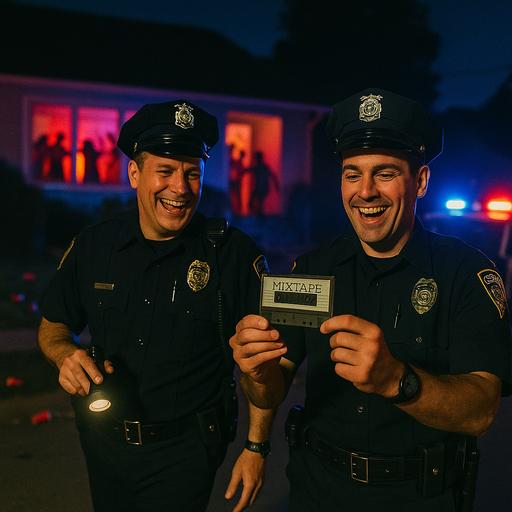
In an unprecedented series of events last night in Portland, Oregon, police officers raided an underground house party expecting to bust a drug ring but instead found themselves entranced by a wall-shaking mix of illicit beats and erotic basslines. Within the first minute of entry, Officer Brad Jenkins was reportedly caught twerking next to a stripper pole while his partner, Officer Melissa Wong, tried to Shazam the soundtrack blaring through the speakers. “I thought I was on something,” admitted Jenkins, “but turns out it was just the music taking me places.”
Despite the initial goal of seizing drugs and arresting suspects, the official police report claims the officers confiscated only ‘unique audio contraband’ along with several glowing reviews scribbled on official stationary. Chief of Police, Harold Fitzgerald, justified the seemingly odd collection of evidence, stating that the mixtape was now part of a broader investigation into ‘sonic mind control.’ In a peculiar follow-up, the Portland PD Instagram account posted a story featuring snippets of the mixtape under the caption, ‘New soundtrack for stakeouts.’
This unexpected turn of priorities has raised eyebrows among city officials, with some questioning the use of taxpayer money for ‘aural appreciation courses’ now being offered to patrolmen. Mayor Sarah Lin voiced concern that the local police department might be losing focus, suggesting instead to allocate the budget towards traditional crime-fighting resources. However, the city council seems split, with Councilman Gary Mitchell openly supporting the use of ‘auditory engagement’ to boost police morale, citing internal studies that show a 22% increase in officer satisfaction when equipped with subwoofers in patrol cars.
Operation Beatdown, as insiders now cheekily call it, appears to be gaining traction. The operation’s classified documents revealed ambitious plans to host city-sponsored DJ workshops for officers, purportedly to ‘enhance community interaction.’ The directive outlines measurable outcomes such as ‘decibel-level diplomacy’ and ‘rhythmic respect patrols,’ alongside proposed metrics for assessing ‘vibe contribution’ at public events and disturbances.
As the city debates the implications of these events, residents remain puzzled over the new focus of their law enforcement. The initial raid may have flopped harder than a rapper’s debut album, but it seems the cultural resonance has hit its mark. For now, Portland’s streets remain safe, albeit melodically charged, with many wondering if the next 911 call might end with a DJ set rather than handcuffs. ‘Is this how they’re gonna keep the peace now?’ mused local resident and party-goer Tanya Lee. ‘Guess I’ll have to make sure my Spotify playlist is police-approved.’